| REGIONS: Alsace-Lorraine, France |

Alsace-Lorraine : Strasbourg Cathedral
The Strasbourg Cathedral
Strasbourg Cathedral, also known as the Cathedral of Our Lady of Strasbourg and Cathédrale Notre-Dame de Strasbourg, is widely considered to be one of the finest examples of Gothic architecture.

Photo: Pixabay: Siegfried Poepperl (Gruendercoach).
Towering above the city of Strasbourg, Notre Dame Cathedral is an icon of Gothic architecture and a collaboration of French and German culture. Its pink sandstone walls and circular Rose Window, built over several centuries and combining both Romanesque and Gothic styles, have influenced architecture across the continent of Europe..
About Strasbourg Cathedral
Construction on Strasbourg’s Notre Dame Cathedral began in 1015. The crypt and footprint remain the only parts of the building from this time. Work on the current cathedral began in the late 1100s and took over three centuries to complete. Funding shortages delayed construction until 1253, at which point the bishop cut his personal expenses to finish the nave.
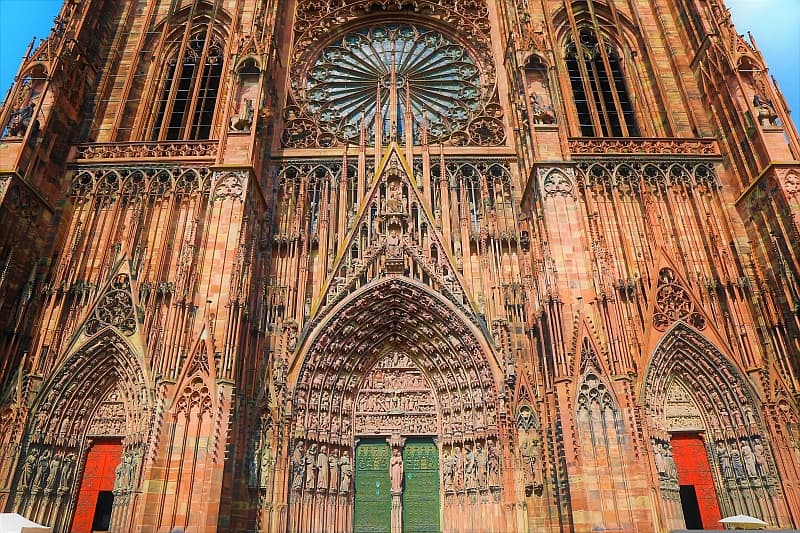
Photo: Pixabay: Konevi.
Erwin von Steinbach redesigned the cathedral in the 1260s and his proposals detailed extravagant architectural features and unique decorations. Strasbourg was then under German rule, and the cathedral was to be the most modern building in the Holy Roman Empire. The Cathedral of Notre Dame in Strasbourg was daring in its application of gothic style and, unlike other cathedrals in Germany, did not adopt the traditional architectural features of the region.
The next two centuries saw construction slowly completed with a few amendments to the original plans. In 1439, builders finally erected the spire, finishing the bell tower as the last part of Strasbourg Cathedral. Reaching 142m tall, Strasbourg cathedral is still the highest medieval structure in Europe. Visitors must climb 332 steps to see the view from the tower.
Key Features of Strasbourg’s Gothic Cathedral
Strasbourg Cathedral is an excellent example of gothic architecture, though the building also has Romanesque features dating back to before 1225 when there was a change of craftsmen. With its spire soaring 142m above the city, Our Lady of Strasbourg Cathedral was the highest building in the West until the nineteenth century.
The cathedral’s traditional cross-shaped design features a long nave at its entrance, typical of Christian churches. Built in the Romanesque style, the chancel at the front of the cathedral is the oldest visible part and conceals an 11th century crypt below. Stained-glass windows from the 12th and 14th centuries beautifully depict biblical scenes.
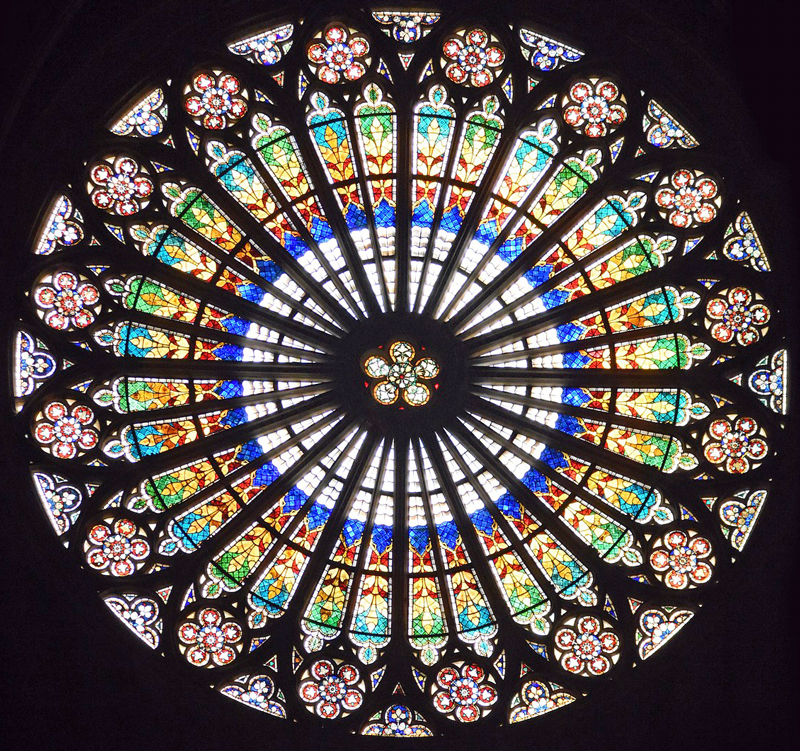
Photo: Pixabay: Denis Doukhan.
The Passion of Christ inspired the decorations on the central portal, flanked by Old Testament statues. The Rose Window, measuring 15 meters in diameter, also sits at the front of the cathedral. Featuring ears of wheat, it is completely unique to Strasbourg Cathedral and represents the city’s commercial power in the Middle Ages.
Hundreds of sculptures line the outside of the cathedral. The architect designed them to silhouette the sky, making use of light and shadow throughout the day. The color of the sandstone also changes relative to the light illuminating it. The cathedral’s walls glow pink or brown according to the time of day, unfortunately though, pollution has given the sandstone a gray tinge.
Other noteworthy features of Strasbourg Cathedral are the pipe organ and the magnificent clock.
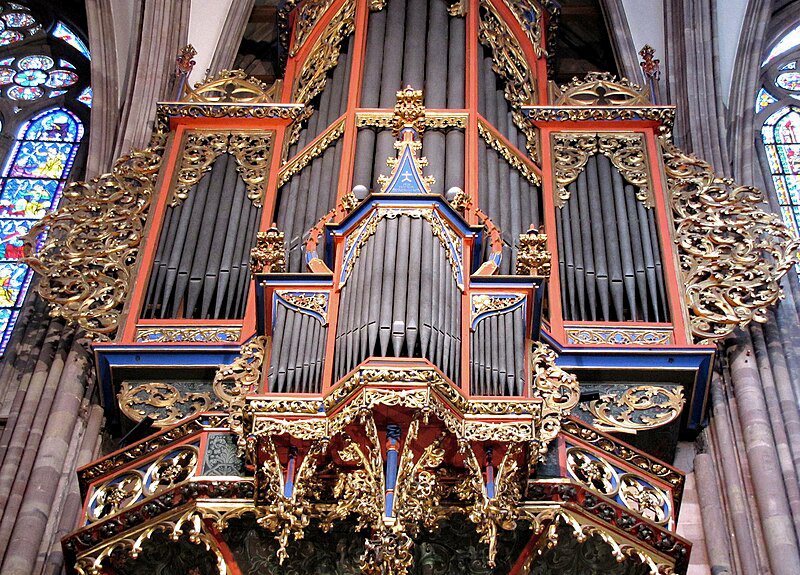
Photo: ©Ralph Hammann – Wikimedia Commons
Records indicate that the grand pipe organ, located high on the wall of the north side of the nave, existed in 1260. Various builders rebuilt it in 1298, 1324–1327, 1384, 1430, and 1489. Later, workers placed the organ in its present position in 1327. André Silbermann finally rebuilt it in 1716. The ornate and colorful decoration of pinnacle, spires, and sculpture, include a moving figure of Samson opening the jaws of a lion, a trumpet player carrying a banner, and a pretzel vendor. The Silbermann organ had three keyboards, thirty-nine effects, and 2,242 pipes. Electrified around 1807, it underwent multiple restorations, most recently between 1975 and 1981, giving it its current 47 effects. In addition to the grand organ in the nave, the cathedral has two smaller organs.
The Astronomical Clock is a technological marvel with a working mechanism dating back to 1842. Mechanical figures of Angels, Death, and the Apostles parade out throughout the day.
Strasbourg Cathedral – A Protestant Place of Worship
Built as a Catholic place of worship, Strasbourg Cathedral changed alliance during the reformation. In the 1500s, Martin Luther’s writings spread throughout Germany, with Strasbourg and the Cathedral of Notre Dame becoming a protestant stronghold. In 1518, Martin Luther posted his theses on cathedral doors, and the town’s many print houses spread his reformist ideas rapidly.
By 1524, the Holy Roman Empire had declared Strasbourg a “Free City”. The Habsburg ruler, Charles V, was less than impressed and sought to return the city to Catholicism. Protestants retained control of Strasbourg and its cathedral for over a century before Louis XIV reinstated Catholicism in 1681 following the Wars of Religion.
Gothic Revival in the 1800s
After falling out of fashion in the late eighteenth century, Strasbourg Cathedral found renewed interest thanks to a visiting German poet. Strasbourg’s Cathedral of Notre Dame inspired Johann Wolfgang von Goethe so deeply that he famously described it as a “sublimely towering, wide-spreading tree of God” in his essay On German Architecture. Fascinated by the cathedral’s identity, he viewed it as the product of a unique collision between French and German influences.
Goethe’s work led to a Gothic resurgence in nineteenth-century France. Politician Victor Hugo romantically wrote that Strasbourg Cathedral was “a skillful combination of monumental size and delicateness”. Incredibly, the sudden renewal of interest in Strasbourg’s Gothic architecture influenced the redesign of the Notre-Dame Cathedral in Paris.
Conflict at Strasbourg Cathedral

Photo: Claude Truong-Ngoc / Wikimedia Commons – cc-by-sa-3.0.
During the French Revolution, the Gallery of Apostles at the top of the south façade had over 230 statues destroyed. A local official saved 67 other statues from the same doom by hiding them from republicans.
When the Franco-Prussian wars struck in 1870, Strasbourg Cathedral came under siege again. Fire destroyed the nave and choir stalls during the conflict. Disaster struck a third time during the First World War when authorities removed all the cathedral’s bells. Later, in World War Two, German forces absconded with the medieval stained-glass windows. Thankfully, in 1945, Allied forces recovered these priceless artefacts from a German salt mine, and they swiftly returned them to the Notre Dame Cathedral in Strasbourg.
UNESCO World Heritage Listed Landmark
UNESCO added Strasbourg Cathedral to the World Heritage List in 1988. Its designation is tied to Strasbourg’s Gothic historic center, built during the 1871–1918 German administration. The resulting urban space surrounding the cathedral is individual to Strasbourg and sees its buildings blending into pastoral views of landscapes, rivers and canals.
Visit Strasbourg Cathedral on a Luxury Barge Cruise
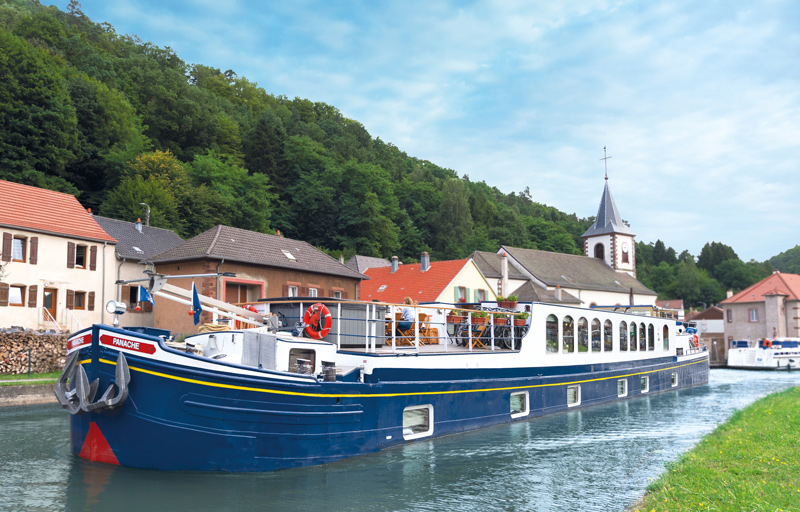
We represent two French hotel barges (La Nouvelle Etoile and Panache) that offer cruises between Niderviller and Krafft along the Canal de la Marne au Rhin and the Canal du Rhone au Rhin.
These waterways flow through steep-sided forested valleys, canal-side villages of half-timbered houses, and feature the amazing Arzviller boat lift which carries the barge sideways 450 feet up the hillside, and several tunnels.


HOME > REGIONS > FRANCE > Strasbourg Cathedral
PARADISE CONNECTIONS
Your Barging Specialists
www.BargeCharters.com
5/23/2026